loading
Paidong Industrial Zone Qiligang,Yueqing City,Zhejiang province,China.
Shopping Cart
  • No products in the cart.
  • Building a Stable Zigbee-Based Energy Monitoring System for a Large Campsite

    A Real-World Case Study Without Cloud Dependency

    Managing electricity in large outdoor facilities is fundamentally different from residential smart home scenarios. Scale, reliability, cost control, and data ownership matter far more than app features or cloud dashboards.

    This case study shares how a large campsite in Denmark successfully built a stable, local, Zigbee-based energy monitoring system for hundreds of power outlets—without relying on cloud services and without ongoing subscriptions.

    Project Background: A Large, Distributed Power Network

    Jelling Family Camping operates a campsite covering approximately 55,000 m², with a total of 392 power outlets distributed across:

    • 42 cabins, most equipped with three-phase meters

    • 350 camping pitches, each with its own DIN-rail energy meter

    Electricity usage must be monitored accurately and fairly, while ensuring uninterrupted power supply for guests throughout the season.

    The Initial Challenge: When Wi-Fi Was Not Enough

    Before switching to Zigbee, the campsite relied on a Wi-Fi-based energy monitoring system connected to Home Assistant.

    Although the system ran for three seasons, it suffered from persistent issues:

    • Unstable connections

    • Frequent dropouts

    • High maintenance effort

    • Difficult troubleshooting across a wide outdoor area

    In a real-world infrastructure environment—especially outdoors—Wi-Fi proved unreliable at scale.

    The goal was not to add “smarter” features, but to achieve consistent, predictable operation.

    Why Zigbee Was Chosen for Energy Monitoring

    To evaluate alternatives, a small test was conducted using DIN-rail Zigbee smart energy devices.

    The result was unexpected in the best possible way:
    the Zigbee system simply worked.

    Key reasons Zigbee was selected:

    • Mesh networking, ideal for wide-area deployments

    • Stable communication with low bandwidth requirements

    • No dependency on continuous internet connectivity

    • Strong performance in environments where Wi-Fi struggled

    The initial test units were deployed quickly and proved reliable enough to justify full-scale rollout.

    System Architecture Overview

    Rather than relying on a single commercial “black-box” platform, the system was designed around local control and modular components.

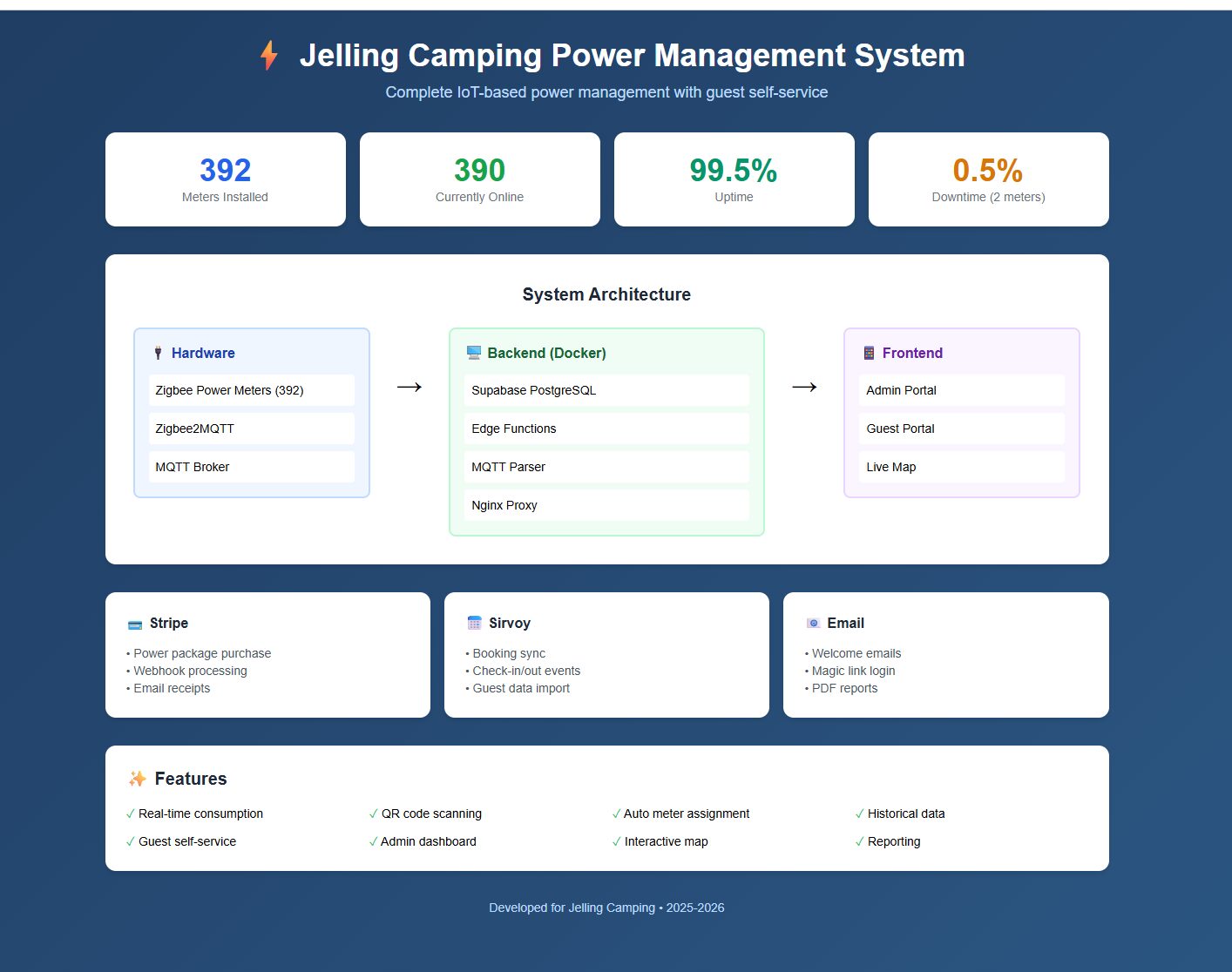
    Core system components included:

    • Zigbee Ethernet gateways

    • Zigbee range extenders for mesh stability

    • DIN-rail Zigbee energy meters

    • Zigbee mini circuit breakers for control and protection

    • A local Linux-based server for data processing and logic

    The system initially integrated with Home Assistant, but later evolved into a custom-built local control system, developed with the assistance of AI tools—without traditional programming experience.

    Local-First Design Philosophy

    One of the most important design decisions was to keep all data local.

    This delivered several key advantages:

    • Full data ownership

    • Simple GDPR compliance

    • No reliance on external cloud platforms

    • Continued operation even during internet outages

    Campers always have power—even if the network goes offline.

    Cost Structure and Scalability

    Cost efficiency was a critical requirement.

    The final system achieved:

    • Under €25 per power outlet

    • No subscription fees

    • Easy expansion by adding new devices to the mesh

    Compared to commercial turnkey solutions, the total investment was less than one tenth of the cost, while retaining full control and flexibility.

    Operational Results After Deployment

    After full deployment, the system delivered impressive real-world results:

    • 392 active meters in continuous operation

    • 99.99% uptime

    • Only 2 faulty units out of approximately 400 devices

    Those two units showed intermittent on/off behavior. The response was straightforward: immediate return labels and fast replacements, with no operational disruption.

    From an operational perspective, maintenance became predictable rather than reactive.

    Why Local Systems Matter in Real Infrastructure

    This project highlights an important lesson for smart energy systems:

    Cloud connectivity is optional.
    Reliability is not.

    By prioritizing local operation, mesh communication, and simple system logic, the campsite achieved stability that cloud-dependent systems often fail to deliver in outdoor and infrastructure-scale deployments.

    Key Takeaways from This Case

    This real-world deployment demonstrates that:

    • Zigbee is well suited for large, distributed energy monitoring systems

    • Local control significantly improves reliability and resilience

    • Ownership of data simplifies compliance and long-term operation

    • Cost-effective systems can scale when designed correctly

    • Engineering decisions matter more than brand ecosystems

    Final Thoughts

    Smart energy systems succeed not because they are “smart,” but because they are designed for reality.

    This campsite project shows that with the right architecture and communication choices, it is possible to build a large-scale, reliable, and affordable energy monitoring system—without cloud dependency and without unnecessary complexity.

    Johnson Lim

    Johnson Lim

    Johnson Lim is the General Manager of Changyou Technology and has over 10 years of experience in circuit protection technology and residential electrical safety. He is committed to developing and producing safer and smarter electrical products.

      Table of Contents