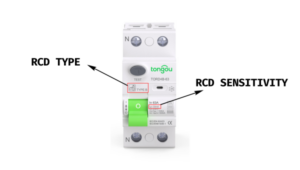
How to Choose 30mA, 100mA, or 300mA RCD Protection for Different Applications
How to Choose 30mA, 100mA, or 300mA RCD Protection for Different Applications When selecting an RCD, many buyers and installers focus first on the leakage
Choosing the right communication method is one of the most critical decisions in electrical monitoring systems. Whether you are monitoring smart breakers, energy meters, or distribution panels, the communication layer determines how reliable, scalable, and maintainable the entire system will be.
RS485, Ethernet-based networking, and wireless connectivity are all widely used in modern electrical monitoring, but they are not identical types of communication standards. In practice, they represent three common communication approaches used at different layers of a monitoring architecture. This article compares them from a system perspective, focusing on reliability, distance, noise immunity, integration, and long-term operation.
Strictly speaking, this article compares three communication approaches used in electrical monitoring rather than three like-for-like protocols: RS485 as a field serial interface, Ethernet as a wired network backbone, and wireless as a cable-free access method. Upper-layer protocols such as Modbus can run over different lower-level communication paths depending on the system architecture.
Electrical monitoring systems are not typical IT networks. They operate in environments with:
–Electrical noise and interference
–Long cable runs
–Distributed devices across panels and buildings
–Requirements for long-term stability rather than high data speed
A communication protocol that works well in an office network may perform poorly inside a distribution board or an industrial workshop.
In other words, the real question is not which technology is universally best, but which communication approach fits the field layer, the system backbone, and the operational requirements of a given monitoring project.
Selecting the wrong communication method often leads to:
-Intermittent data loss
-Unstable readings
-Difficult troubleshooting
-Higher maintenance costs over time
RS485 is a physical-layer serial communication standard widely used in industrial and electrical monitoring systems. It defines how signals are transmitted electrically on a balanced serial bus, and it is often paired with upper-layer protocols such as Modbus RTU for device communication.
-Differential signaling with high noise immunity
-Long communication distance, often up to about 1200 m at lower data rates when cable selection, bus design, and termination are handled correctly
-Multi-drop topology (many devices on one bus)
-Low bandwidth, but highly stable
RS485 does not define data meaning or structure by itself. It defines how signals are transmitted electrically, which is why it is often combined with Modbus for device communication.
Distribution panels with many devices
Electrically noisy environments
Long-distance cable runs
Systems that prioritize stability over speed
RS485 remains popular because it is predictable and robust, not because it is new.
Ethernet is a family of wired networking technologies widely used in IT and industrial systems. In electrical monitoring, Ethernet is often used as a backbone or integration layer, carrying protocols such as Modbus TCP and connecting monitoring devices to servers, BMS, SCADA platforms, or cloud systems.
-High data bandwidth
-Standardized network infrastructure
-Easy integration with IT systems, servers, and cloud platforms
-Supports complex network topologies
Ethernet excels when monitoring data must be integrated into larger systems such as BMS, SCADA, or enterprise energy platforms.
This is especially true in typical copper-based field deployments.
Typical copper link distance is shorter, commonly around 100 m without additional active infrastructure
Lower tolerance to electrical noise compared to RS485
Higher infrastructure complexity
Ethernet is powerful at the system level, especially when monitoring data must integrate with BMS, SCADA, servers, or cloud platforms. In field-level electrical environments, however, copper Ethernet usually requires more careful infrastructure design than RS485.
Wireless communication is not a single protocol, but a category of cable-free connectivity methods, including Wi-Fi, cellular, Zigbee, and proprietary industrial wireless solutions. In electrical monitoring, wireless is often used where cabling is difficult, expensive, or impractical.
No physical cabling
Fast deployment
Useful for retrofits and temporary installations
Susceptibility to interference
Dependency on signal coverage and network stability
Latency and reliability variability
In many electrical monitoring projects, wireless works best as an access or last-hop layer unless the application has been specifically designed and validated for high-reliability wireless operation.
| Comparison Dimension | RS485 | Ethernet | Wireless |
|---|---|---|---|
| Distance | Best for longer field runs | Strong in structured wired networks | Flexible, but signal-dependent |
| Noise Immunity | Strong in noisy environments | Good, but depends on cabling quality and infrastructure | More affected by interference and physical obstacles |
| Infrastructure Complexity | Simple bus wiring with relatively low infrastructure demand | Requires switches, ports, and more network planning | Reduces wiring needs, but requires signal planning and coverage management |
| Integration | Well suited for device-level communication | Best for broader system integration and network connectivity | Useful for remote access, retrofit projects, and flexible deployment |
| Retrofit Flexibility | Moderate, since new cable routing is usually needed | Lower in retrofit projects where network cabling is difficult | Best for retrofit, expansion, and cable-free deployment |
The comparison becomes clearer when these communication approaches are judged against the same engineering criteria rather than against brand features or isolated specifications.
RS485 supports long-distance, multi-drop wiring
Ethernet supports complex networks but requires active infrastructure
Wireless depends heavily on environment and coverage
RS485 performs best in electrically noisy environments
Ethernet requires shielding and proper grounding
Wireless is vulnerable to RF interference
RS485 can scale efficiently for multi-device field networks when bus design, termination, and baud rate are properly managed.
Ethernet scales well at the system level with switches and routers
Wireless scales easily in number but not always in reliability
RS485 systems are simple but require protocol knowledge
Ethernet systems benefit from standard network tools
Wireless systems can be difficult to diagnose when signal quality fluctuates
In real projects, communication methods are often combined rather than chosen in isolation.
A common architecture:
RS485 for field-level devices (meters, breakers)
Ethernet for aggregation and system backbone
Wireless for remote access or difficult wiring locations
This layered approach balances reliability, flexibility, and integration.
It also reflects how many real monitoring projects are designed: a robust field layer, an efficient aggregation layer, and a practical access layer.
There is no universal answer, but practical guidelines include:
– Choose RS485 when field-level stability, long cable runs, multi-drop wiring, and noise immunity are the main priorities
– Choose Ethernet when monitoring data must integrate cleanly with supervisory systems, IT infrastructure, or higher-bandwidth applications
– Choose wireless when cabling is difficult, retrofit speed matters, or the communication path is better treated as access rather than the core control backbone
The best solution is often determined by the environment, not by the technology itself.
No communication architecture can compensate for:
Poor wiring practices
Incorrect grounding
Inadequate protection design
Improper device selection
Communication is a system layer, not a substitute for sound electrical engineering.
Is RS485 the same as Modbus?
——No. RS485 defines the physical electrical layer, while Modbus defines the application-layer structure used to organize and exchange device data.
Is Ethernet always better than RS485?
——No. Ethernet is often better for system integration, but RS485 can be more practical at the field level in noisy environments and long cable runs.
Can wireless be used for electrical monitoring?
——Yes, but in many projects it is best used as an access or retrofit layer unless the wireless system has been designed and validated for high-reliability operation.
RS485, Ethernet, and wireless communication each play an important role in modern electrical monitoring systems. Understanding their strengths and limitations helps engineers design systems that remain reliable not just during commissioning, but throughout years of operation.
From a system perspective, the right communication choice reduces complexity, improves data quality, and lowers long-term maintenance risk.
Johnson Lim is the General Manager of Changyou Technology and has over 10 years of experience in circuit protection technology and residential electrical safety. He is committed to developing and producing safer and smarter electrical products.

How to Choose 30mA, 100mA, or 300mA RCD Protection for Different Applications When selecting an RCD, many buyers and installers focus first on the leakage

Contactor vs Circuit Breaker vs Relay: What Should Control the Load? When you need to control a load, the real question is not which device

What Happens to a Smart Breaker or Smart Energy Meter After a Power Outage? A power outage does not affect every part of a smart

Chayo Project Campsite Energy Management System: Denmark Zigbee Case Study Denmark Campsite Energy Management System with Zigbee Smart Devices Managing electricity across a large campsite

To address any concerns regarding our logo update, please note that the EU trademarks “tongou” (Registration No. 018630309) and “Chayo” (Registration No. 019312969) are both owned by Changyou Technology (Zhejiang) Co., Ltd.
This logo update is only a visual upgrade and does not affect the ownership, validity, or exclusive use of the above trademarks. It also has no impact on product quality, performance, specifications, after-sales service, or business cooperation.
All products and services remain consistent and reliable as always.
Marine Economic Development Demonstration Zone, Wenzhou City, Zhejiang Province, China
Sales: [email protected]
After-sales: [email protected]
© 2026 Changyou Technology. All Rights Reserved.